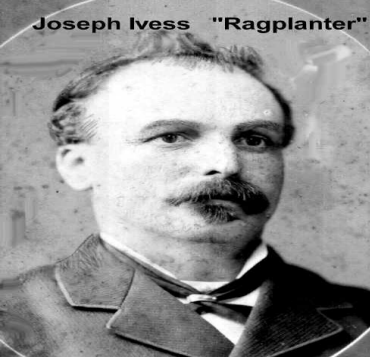
Joseph Ivess "Ragplanter"
Born
1844 Askeaton, Ireland.
Died 1919 Christchurch New Zealand
Wherever He
Wandered A Newspaper Sprang Up.
Born in
Askeaton Co' Limerick, Ireland,
the son of John Pope Ivess and Anne (nee Southwell) Grandson
of Patrick & Jane. Joe's family emigrated
to Australia around 1852. They came on
the Vessel Alcyon which left Liverpool in 1852.
The family settled in Melbourne, Victoria, later moving to
Maldon. Having learned the printing trade he set out at
the age of 24 following the death of his
father, to carve his destiny in 1868 at the gold
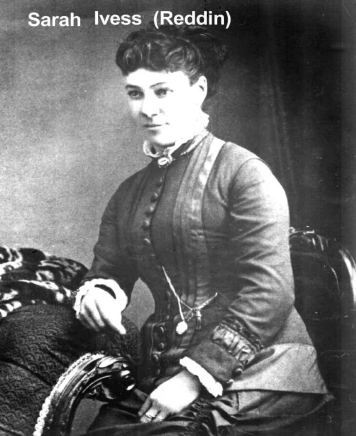
fields on the West Coast of New Zealand with his wife Sarah
(nee Reddin) and all his sisters followed
shortly after, except Lucy who remained
in Australia married (Horan)
According
to G. H. Scholefield, Joseph Ivess established forty-five
newspapers in New Zealand and Australia. Even
though Scholefield later modified his estimate to twenty-six
New Zealand and five Australian titles, this still high
number calls for explanation. For one man to 'plant' over
thirty newspapers during his working life is nothing short
of extraordinary. Scholefield's statements raise two major
questions: which newspapers did Ivess establish and why did
he establish them?
The first
question is the easier to answer, although to do so is
impeded by the lack of an adequate bibliography of
newspapers published in New Zealand. The disappearance of
many of this country's newspapers is a further impediment.
Some evidence can be gleaned from the few Ivess newspapers
which can still be located. But this combined with the
evidence in secondary sources is insufficient to confirm the
precise number of titles in which Ivess had an interest. In
addition, the nature and extent of that interest is
sometimes by no means clear. I have in the Appendix
identified forty-four newspapers published in New Zealand
which have some connection with Ivess, (twenty-nine
definitely established by him) but have identified only two
Australian newspapers as being Ivess titles.
Having refined
Scholefield's figures, the second question can be addressed:
why did Ivess establish this large number of newspapers?
What were his motivations? Several of his titles proved
themselves capable of providing at the least a comfortable
living, so the explanation cannot be made solely on the
grounds of economic necessity. Scholefield, himself a former
newspaper editor who had met Ivess, suggests a reason: Ivess
was the most picturesque of that gay band of pioneers who,
with a handpress and a hatful of type, rushed from point to
point . . . to hoist the banner of free journalism wherever
men needed such an organ of expression. This may present
part of the truth, but probably only a small part. Ivess
stressed many times in his editorials that he was a
businessman, with the motivations of earning a living and of
making a profit which that entails. He may also have had a
more detached interest in principles of free speech and
democracy, and may well have considered his newspapers as a
vehicle through which the common man could express
himself, but this was probably a secondary concern.
Scholefield notes an element of
restlessness in Ivess's makeup: 'The grass over the fence
always looked greener than that in his own paddock'. Ivess
must also have enjoyed the social status attached to being a
newspaper editor or proprietor in a small town. But I
consider that Ivess's primary motivation was a wish to be in
the centre of the political world and to wield political
power, and he used the newspapers he established or leased
to further these political ambitions. The study which
follows of his newspapers, taking special note of certain
years of the Inangahua Herald the Patea Mail and the
Paraekaretu Express, will establish this more clearly.
Ivess was by no means alone among newspapermen in succumbing
to the lure of political power. It may even have assumed the
status for New Zealand newspapermen of an occupational
hazard: there was a higher than usual extent of combining
the journalistic and political roles in this country,
according to Patrick Day.
One characteristic of nineteenth
century South Australian newspaper editors was that they
often entered politics at the local or national level, just
as Ivess in New Zealand held posts in local, provincial and
national governments. A similar point has been made about
English newspaper proprietors:
The access papers have afforded to
public life has been a major factor. That access has, on a
few occasions, been converted into real political power. But
for the most part it has been an illusion. Ownership has
been a ticket to the front stalls of public affairs, but not
to the stage itself. Apart from
some early successes, political power was to elude Joseph
Ivess.
Biographical information about
Joseph Ivess is readily available. He was born in Askeaton,
Co. Limerick, Ireland, on 8 February 1844, and in 1852
accompanied his parents to Melbourne, where he was educated
at Barnett's Grammar School, Emerald Hill. His father, John
Pope Ivess, was a police sergeant. In 1866, after his
marriage to Sarah Ann Reddin, he worked on the staff of the
Bendigo Independent. On his arrival in New Zealand in 1868
he began work as the manager, and perhaps printer, of the
New Zealand Celt at Hokitika. He remained in and about the
West Coast for the next eight years, but after 1875 his base
became the Canterbury region, and particularly Ashburton.
A photograph of Ivess with his family shows nine
children.
He represented the electorate of
Wakanui, South Canterbury, in the House of
Representatives on two occasions, 1882-1884 and 1885-1887,
after that concentrating his activities in the North Island,
especially in the Taranaki and Rangitikei areas. He returned
for some years to Ashburton around the turn of the century,
and from 1903 based himself in the central North Island. He
died on 5 September 1919 in Christchurch.
A description of Ivess in late 1875 portrayed him as
a fine plump man with a well-groomed appearance. He wore a
moustache and a little bunch of hair on his under lip, as
was customary in some professional men of those days. . . .
Always an optimist, it was hard for others to compete with
him, and he was certainly a tireless worker, obtaining
considerable influence where he worked.
It is hardly surprising that an
Irishman emigrating from Melbourne to New Zealand would
land at Hokitika. The West Coast goldfields
were at that time full of fellow
countrymen and shipping routes made that coast a natural
landfall. Ivess probably found employment rapidly as the
manager of the New Zealand Celt, the Irish Catholic
Party's newspaper whose proprietor John Manning
was charged with seditious libel for erecting a memorial
to the Fenian martyrs of Manchester in the Hokitika
Cemetery. It may have been in this heady political
atmosphere that the seeds of Ivess's political ambitions
were planted and nurtured. By 1870 Ivess had definitely
established a printing business at Hokitika in
partnership with George Tilbrook, as shown by
advertisements in the first issue of the Tomahawk (5
March 1870) and subsequent issues. This heavily
satirical weekly and its successor the Lantern must also
have encouraged Ivess in his political aspirations, for
they relied on criticism of local and national political
events for their effect. Even at this early stage in his
career Ivess demonstrated a propensity for attracting
legal action, being named as a defendant in a libel
action in the Tomahawk (16 and 30 April 1870). To be
fair, Ivess was not alone among newspapermen in being
sued frequently. Conservative libel laws were retained
in New Zealand long after they had been redrafted in
England and resulted in frequent law-suits of which
Ivess attracted his fair share.
The New Zealand people recently
honoured the memory of Joseph Ivess by naming the tallest
peak in the Victoria Range near Inangahua in the South
Island
" IVESS
PEAK"
|

